
Hammurabi Code of Law
QUESTION: Hammurabi Code of LawANSWER:
Why was the Hammurabi Code of Law such an important archaeological discovery? The Law Code of Hammurabi is significant because it is one of the oldest set of laws yet discovered by modern archaeologists. It dates back to around the 18th century B.C. Hammurabi was the Babylonian king who conquered the Sumerian dynasty of Isin, thus bringing an end to the centuries-long Sumerian domination of Mesopotamia. His own dynasty collapsed following his death, but the code of laws which he instituted endured.
The Code of Hammurabi is of special interest to biblical archaeologists because of the similarities between it and the Mosaic Law. Instances of correspondence include the famous "eye for an eye" principle. This has led some scholars to speculate that Moses, who lived around three centuries after Hammurabi, borrowed his law from the Babylonian monarch. This view has been discredited however. The similarities are limited and often superficial. For example, in the Mosaic Law, the "eye for an eye" principle is universal. In the Hammurabi Law the "eye for an eye" principle only applies if both parties are of equal status (i.e. lower class, middle class, upper class, clerical, nobility, etc.).
The Law Code of Hammurabi shown below is preserved on a seven-foot-tall, black diorite stele, which depicts the king himself receiving the law from Shamash, the Babylonian god of justice. The Law Code of Hammurabi provides incredible insight into the civil laws and customs of the ancient world, and shows similarities to the laws contained in the Torah (first five books) of the Bible.
The Law Code of Hammurabi currently resides in the Louvre Museum, Paris.
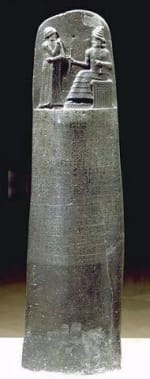
© 2003 Stan Rummel. See our Copyright Notice
What do you think?
We have all sinned and deserve God’s judgment. God, the Father, sent His only Son to satisfy that judgment for those who believe in Him. Jesus, the creator and eternal Son of God, who lived a sinless life, loves us so much that He died for our sins, taking the punishment that we deserve, was buried, and rose from the dead according to the Bible. If you truly believe and trust this in your heart, receiving Jesus alone as your Savior, declaring, "Jesus is Lord," you will be saved from judgment and spend eternity with God in heaven.
What is your response?
What is your response?


